All articles
How to sell on social media without a website
Discovery, decision and payment happen in three different places, and you only control one of them. The honest architecture of selling without a site.
Sailo team14 min read
On this page
- A sale happens in three places, not one
- Discovery is rented, and it always will be
- The decision happens on one page, and that page is yours
- Payment is the part you control least and worry about most
- Trust moves before money does
- What each channel is actually good at
- Forty orders a month in Lagos
- The point where a chat thread stops scaling
- When someone else's shop is the better answer
- What this honestly costs
- Start with the page, not the platform
- Where to go from here
You have a few thousand followers, "how much?" under every third post, and you spent this afternoon answering the same question in Instagram DMs, in WhatsApp, and in the comments. No website. Someone has told you that you need one.
You don't. You need three things and only one of them is a page.
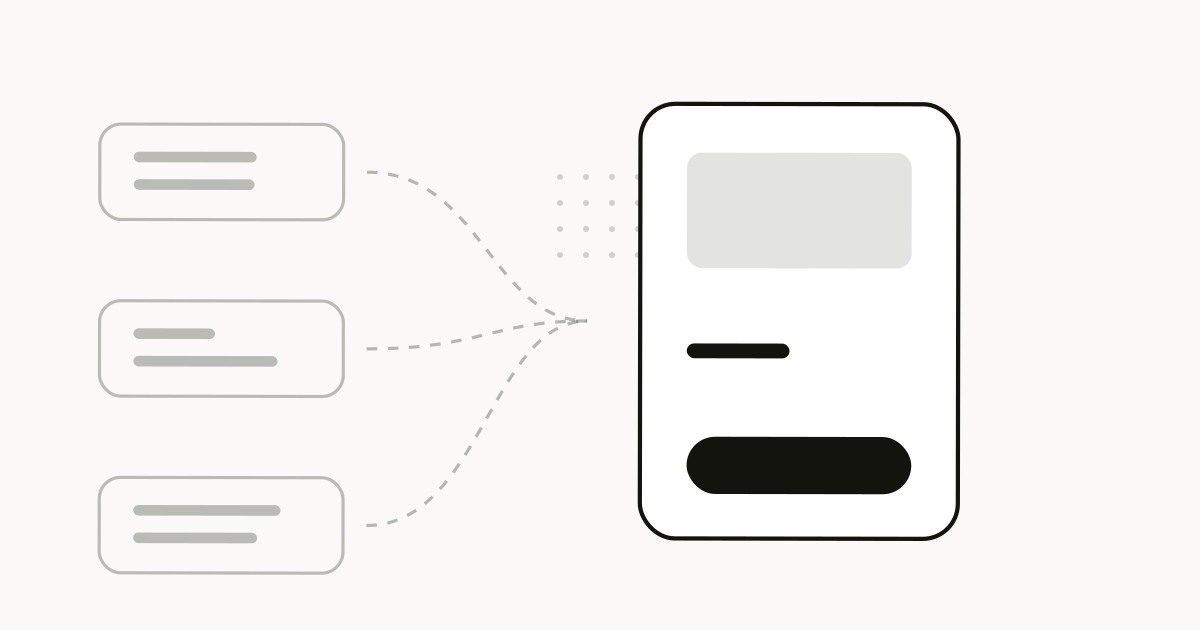
Selling on social media without a website works because the jobs a website normally does can be pulled apart and handed to different places. People find you on social. People decide on one page with prices on it. People pay on whatever rail they already trust, which in Lagos is a bank transfer, in Manila is cash on delivery, and in Dubai is a WhatsApp message with the total already typed into it. Sailo covers the middle piece: a shop at sailo.store/yourname, live the minute you sign up, free for up to 10 products.
That's the architecture. The rest of this is how each of the three parts fails, and which one is worth your attention.
A sale happens in three places, not one
Write these down, because the whole thing gets easier once you stop treating them as one event.
Discovery is where a stranger first sees the thing. A reel, a post someone reshared, a friend who tagged them, a hashtag, a live. Discovery is where almost all your effort currently goes.
Decision is where they work out whether they want it at that price. This is the quiet part. It happens in about eight seconds, usually while they're standing somewhere, and it ends with either a tap or a scroll.
Payment is where the money moves. Transfer, card, cash at the door, a till number, a link.
Now the uncomfortable bit. You control exactly one of those three, and it isn't the one you're spending your Sundays on.
Discovery belongs to a platform that changes its mind about you without warning. Payment belongs to a bank, a wallet or a delivery rider. Decision is yours, entirely, and it's the one most sellers have never actually built anything for.
Discovery is rented, and it always will be
Reach is not an asset. You can have a reel do 400,000 views in February and eleven posts in a row do 900 views in March, with no change to what you're selling or how you shoot it. Every seller who has been at this longer than a year has a story like that.
What follows from it is practical, not philosophical:
- Don't build your ordering process on a feature one platform owns. If your entire checkout is an Instagram story sticker, you're one product change away from starting over.
- Post where discovery is cheap, but move the buyer to something you control before you ask for money.
- Don't spread across five platforms because a guide told you to. Two done properly beats five done at 30%.
The useful way to think about a platform is as a place you rent an audience for free, on the condition that you never get to keep the keys. That's a fine deal. Just don't renovate the kitchen.
The decision happens on one page, and that page is yours
This is where selling without a website is either real or a mess.
A buyer who taps your profile has three questions, in this order:
- What do you sell?
- What does it cost?
- How do I get it?
If the page they land on answers all three without a second tap, you have a shop. If it answers none of them and offers a menu of buttons, you have a directory, and the buyer has to go find the shop themselves. Most of them won't. We wrote about that specific leak in why your link in bio is costing you sales, and the short version is that every handoff between apps is a place buyers stop.
The price is the part people get wrong. Sellers hide prices because they want the conversation, and the conversation feels like a relationship. It isn't. It's a queue. A buyer who has to DM to learn the price is a buyer doing unpaid work, and the ones who don't feel like doing it just leave, silently, and you never learn they existed.
The message that kills an order isn't "too expensive". It's "let me get back to you", and you get that one every time a buyer has to do arithmetic in a chat window.
What actually belongs on that page, and what to cut, is its own decision. There's a full breakdown in what to put in your bio link.
Payment is the part you control least and worry about most
Here's the honest map, market by market, of how money actually reaches a small seller.
| Where | What buyers expect | What you have to do |
|---|---|---|
| Nigeria | Bank transfer, then a screenshot | Check your own bank app before you ship |
| Philippines, Indonesia, Vietnam | Cash on delivery, mostly | Confirm the address, absorb the failed deliveries |
| Kenya | M-Pesa till or paybill | Buyer sees your registered business name, which is trust you didn't have to earn |
| India | UPI to a UPI ID, no gateway, no setup | Match a UTR to an order by hand |
| Gulf | Card link or transfer, arranged in WhatsApp | Send the total in the same thread as the order |
| US, UK | Card, mostly | Pay the processing fee and move on |
Two things to take from that table. First, in most of the world the buyer's preferred rail needs no gateway and no website at all. Second, on every one of those rows except the card ones, you are the one who confirms the money arrived. Nobody does it for you.
That's true of Sailo too, and it's worth saying plainly. Sailo can record that an order was placed and that you marked it paid. It cannot see your bank account, so it cannot tell you a transfer landed. Only your bank can do that. If you want the process for handling that without either shipping to a fraudster or insulting a real customer, it's in how to take payment as a small seller.
Trust moves before money does
In a lot of markets the reason a buyer hasn't ordered has nothing to do with your page. They don't know whether you're real.
This is the part that a website was quietly doing for you, and the part sellers forget to replace. A site with an about page, an address in the footer and a returns policy is boring, and boring is exactly what it was for. Without one, you have to put that reassurance somewhere else, and social is actually better at it than a footer ever was.
What works, in rough order of how much it moves the needle:
- Your face or your workshop, on camera, at least sometimes. A single unpolished video of you packing orders does more than any badge.
- Replies where other people can see them. A public "sent yesterday, thank you!" from a stranger is worth more than a testimonial you typed yourself.
- Delivery photos. Not the product. The parcel, at someone's door, with the courier's label visible.
- A stated turnaround you keep. "Ships Tuesday and Friday" is stronger than "fast delivery", because one of them can be checked.
Kenyan sellers get a piece of this for free. Pay to an M-Pesa till and the buyer sees the registered business name on their phone before they confirm. That's a small, real signal that somebody registered something, and it lowers the temperature of a first order in a way a screenshot of an account number never does.
There's a specific point in this where sellers lose orders and blame the price. A buyer asks a question in the DMs, you answer it two hours later, and by then they've bought something similar from an account that answered in four minutes. The trust wasn't lost on the product. It was lost on the wait.
Notes on selling, twice a month
One email on pricing, photographs, delivery and getting paid. No pitch, no filler.
What each channel is actually good at
Channels aren't interchangeable. They fail differently, which means you should use them for different jobs.
Instagram is discovery and desire. It's where people see the thing and want it. It's a poor place to run an order because you cannot prefill a message, so every order arrives as whatever the buyer felt like typing. The workarounds that actually help are in turning Instagram DMs into orders.
WhatsApp is confirmation and closing. It's where the address gets given, the total gets agreed, and the receipt gets sent. It's the best chat channel for orders precisely because a link can arrive with the message already written. Details in how to take orders on WhatsApp.
Comments are reach. Comment-claiming, where the first person to type "sold" or "mine" gets the item, is the cheapest distribution most small sellers have, because every claim is engagement and every reply is more of it. It's also the fastest way to sell the same jacket to two people. The mechanics, including the double-claim problem, are in selling in comments without losing track.
Your shop page is the decision. Prices, options, stock, and a button. It's the only one of the four you'd still have if a platform banned you tomorrow.
The trap is trying to make one channel do all four jobs. A WhatsApp thread is a wonderful place to close an order and a terrible place to browse a catalogue. A comment section is a wonderful place to create urgency and a terrible place to store a customer's address.
Forty orders a month in Lagos
Chidinma sells hair oil in Lagos. One product, 100ml, ₦8,500 a bottle. She has about 6,000 followers on Instagram, posts three times a week, and does roughly 40 orders a month.
Before she had a shop page, her routine was this. Post. Get 20 to 30 "price?" comments. Reply to each with a price. Get maybe eight DMs. Type the price again in each. Ask for the address. Get the address in three separate messages. Ask them to transfer to her Access Bank account, type the account number, wait, get a screenshot, open her bank app, check, then ask for the address again because it's now 40 messages up the thread.
She timed it once. Eleven minutes per order, average, spread over a whole day of interruptions.
The fix wasn't a website. It was putting ₦8,500 on a page, so that the comment reply became a link instead of a number. Now a buyer taps, sees the price and the delivery options for Lagos mainland versus island, fills in the address on the page, and the order arrives in her WhatsApp already written out: one 100ml bottle, mainland delivery ₦2,000, total ₦10,500, address attached.
She still checks her bank app. That part didn't change and won't. What changed is that she stopped typing ₦8,500 forty times a week, and her reply to "price?" is now four words and a link.
The arithmetic that matters: 40 orders at eleven minutes is roughly seven and a half hours a month spent retyping things she already knew. At her margin, that time was worth more than her entire ad spend.
The point where a chat thread stops scaling
Every seller hits this and almost nobody sees it coming, because it doesn't arrive as a crisis. It arrives as a normal Tuesday that goes slightly wrong.
The signs, roughly in the order they show up:
- You start scrolling up in a thread to find an address.
- You send someone else's order confirmation to the wrong person.
- You can't remember whether the woman in Ikeja paid or just said she would.
- You take a day off and the backlog takes three days to clear.
- Two people have claimed the same item and both are polite about it, which is worse.
The threshold is usually somewhere between 15 and 30 orders a week, and it depends less on volume than on how many options your products have. One product in one size, you can run 60 a week from a chat thread. Four sizes and three colours, you'll break at twelve, because the thing that overloads you isn't the orders. It's the variants.
When you hit it, the answer isn't a bigger phone or a virtual assistant. It's moving the part that has structure, item, options, address and total, off the chat and onto a page, and leaving the chat to do what chat is genuinely good at, which is talking to a person.
When someone else's shop is the better answer
This piece would be dishonest if it ended with "so build your own link". Sometimes you shouldn't, or at least not only.
Your own link has one weakness that nothing fixes: it brings no buyers. Not one. Every visitor arrives because you sent them, from a post you made, to an audience you built. A marketplace is the opposite trade. It has buyers already searching, and it charges you for access to them in commission, rules and the fact that the customer is theirs, not yours.
If you're selling something people search for by name, and you have no audience yet, the marketplace probably wins for now. If you have an audience and a margin worth protecting, your own link wins. Most sellers who last end up doing both, deliberately, with different products in each. The full comparison, including the arithmetic on where the crossover sits, is in when a marketplace beats your own shop.
What this honestly costs
Sailo's free plan is $0, holds 10 products, keeps 7 days of analytics, and supports the manual rails: bank transfer, cash on delivery, WhatsApp, Instagram, Telegram, email and phone. Sailo takes no commission on any of those, because Sailo never touches the money.
Card payments are the exception and the limitation worth knowing before you start. They need a Stripe account that Stripe has cleared to take charges, and Sailo takes 1–3% of the goods on each card order, after discounts and excluding delivery and tax. On a $12 order that's six cents to Sailo, on top of whatever Stripe charges. The six cents is not your problem. The $49 is, if you're doing eleven orders a month.
The other thing to know: there is no mobile money rail. No M-Pesa integration, no GCash, no UPI, no Pix. If that's how you get paid, and for a great many sellers it is, you can put your till number or UPI ID into the bank transfer instructions field and the buyer will see it at checkout, but you're the one matching payments to orders. Sailo handles the catalogue and the order. It doesn't handle that money.
Start with the page, not the platform
Do this in the next hour, in this order, because the order matters.
- Pick your five best-selling items. Not twenty. Five.
- Put a photograph and a price on each one. A real price, the one you'd say out loud.
- Add the one delivery option most of your orders use, with its cost.
- Put the link in your bio, and in your WhatsApp Business profile, and in your Instagram highlights.
- Change your reply to "how much?" from a number to a link.
That last step is the one that pays. Everything else is setup; that one is the habit. Give it two weeks and count how many times you typed a price. If the answer is close to zero, the page is doing its job, and you can go back to the part of this that you actually enjoy.
Where to go from here
Once the page exists, the work moves to the channels feeding it. If orders arrive in two places at once, taking orders in the comments and DMs together covers keeping one list instead of two. If you post everywhere, one link for every platform is the setup that stops you maintaining five bios. Sellers who also trade in person should read selling offline and online at once, because stock that exists in one place and sells in two is its own problem, and QR codes that actually get scanned if you print anything.
Two more for when it gets busy: what to do when DMs get out of hand, and selling to a group chat if your buyers already live in one.
Topics
- selling
- social
- channels
Written by
Sailo team
One link, your whole shop.
Notes on selling, twice a month
One email on pricing, photographs, delivery and getting paid. No pitch, no filler.
You're already selling in the DMs.
Sailo just gives it a front door — so people can browse, compare and see prices before they message you.
Get your linkFree while in beta · No card required