All articles
One link for every platform
Use one destination and several tagged entrances. How to pick a link people can say out loud, where it goes on each app, and why most traffic hides.
Sailo team11 min read
On this page
- One destination, several tagged entrances
- The link has to survive being said out loud
- Where the link goes on each platform
- Why most of your traffic reports as "direct"
- Tagging the same link so you can tell TikTok from a newsletter
- Devon's three platforms and one page in Columbus
- When one link genuinely isn't enough
- What this can't do
- Do the boring twenty minutes
You've got a link in your Instagram bio, a different one in your TikTok, a third in a pinned comment on YouTube that goes to a page you edited in March, and someone just asked for "the website" in a DM and you had to think about which one to send.
Stop maintaining four. Maintain one.
A single link for all your social platforms works because the destination and the entrance are different problems. The destination should be one page, at one address, that you never change. The entrance is which app the person came through, and you find that out by tagging the link, not by making a new one. A handle on Sailo can be up to 32 characters and it lives at sailo.store/yourname from the day you sign up, on the free plan, at $0. Pick it carefully, because the whole point of this article is that you're going to print it on things.
One destination, several tagged entrances
Split those two apart and the rest gets easy.
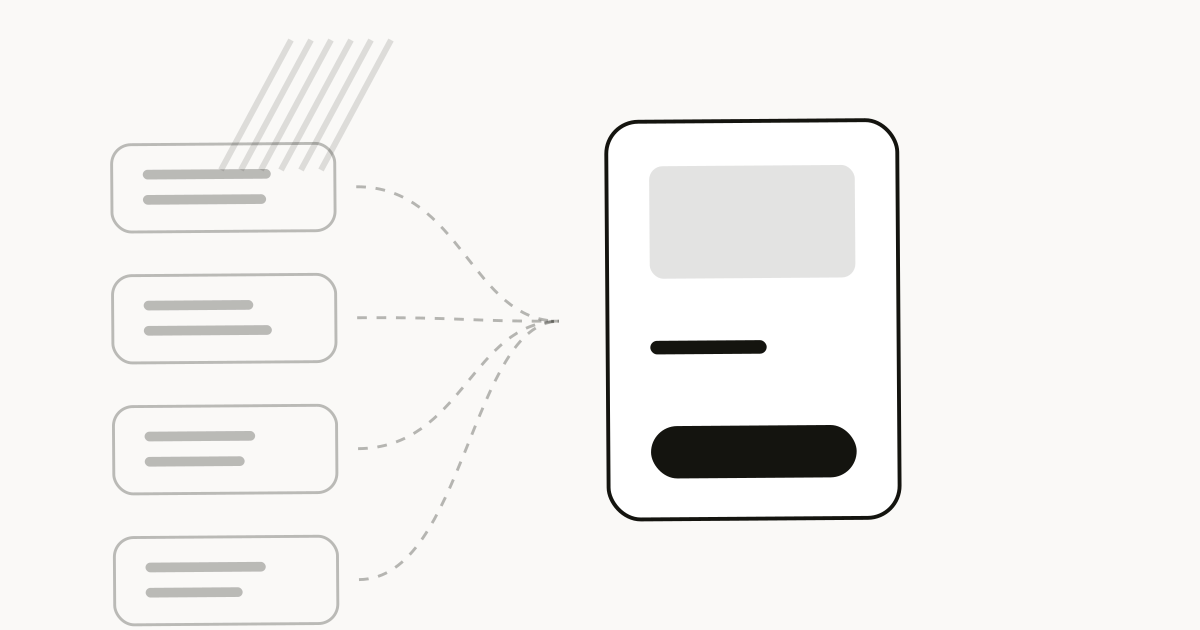
The destination is the page with your products and prices on it. There is one. It has one address. That address goes in your bio, your video descriptions, your parcel inserts, your email signature and your voice when someone asks you at a wedding what you sell.
The entrance is the route a specific person took to get there. TikTok bio, Instagram story, a friend's group chat, a printed card. You want to know this, because it tells you which effort is worth repeating. But you find it out by adding a tag to the end of the same link, not by building a second page.
Sellers get this backwards constantly. They build a TikTok landing page and an Instagram landing page, and six weeks later one of them has a price that's out of date, and the buyer who saw £22 on the old page is now arguing with you about £26.
One page. One price. One thing to update at 11pm when you change your shipping cost.
The link has to survive being said out loud
This is the test almost nobody applies, and it decides more than the page design does.
Say your link to someone in a noisy room. If they can type it correctly from hearing it once, it's a good link. If you have to spell any part of it, it's a bad link and it will cost you every offline conversation you ever have.
What fails the test:
- Underscores. People hear "underscore" and type a hyphen, or nothing.
- Numbers that could be words.
4you,2go,no1. Half of them will type "for", "to" and "one". - Doubled letters at a word boundary.
mollysshopgets typedmollyshopabout half the time. - Anything you have to explain. If the answer to "how do you spell that?" is longer than four words, change it.
What passes: a name, lowercase, one word if you can manage it, hyphen only if the two words genuinely need separating. sailo.store/frankiemakes beats sailo.store/frankie_makes_00.
There's a second, quieter reason this matters. Your handle is not permanent, but the consequences of changing it are. On Sailo you can edit it in settings, and the moment you do, the old address stops working. There's no redirect from the old one, and the handle you just freed up can be taken by somebody else. So every card you printed, every parcel insert, every QR code stuck to a box lid, all of it is now scrap.
Pick the link you'd be happy to still have in two years, then behave as though you can't change it. Because functionally, once anything is printed, you can't.
Where the link goes on each platform
There are more slots than most sellers use, and the unused ones are usually the ones that convert best, because a person who reads a video description is already interested.
| Where | The slot | What actually happens |
|---|---|---|
| Bio link field | Clickable. The one everyone uses and the one people miss | |
| Story link sticker | Clickable, and it disappears in 24 hours unless you highlight it | |
| Highlight cover called "Shop" | Permanent. Almost nobody does this | |
| TikTok | Bio website field | Clickable, though availability depends on your account type and has changed more than once. Check yours |
| TikTok | Pinned comment on your own video | Not clickable, but readable, and readable is enough if the link is sayable |
| YouTube | Description, first two lines | Clickable, and the first two lines are all that show before "more" |
| YouTube | Channel links section | Clickable, permanent, forgotten |
| Facebook Page | Website field and the action button | Clickable |
| WhatsApp Business | Profile website field | Clickable. Every person who opens your profile before messaging sees it |
| X and Threads | Bio website field | Clickable |
| Pin destination URL | The whole point of a Pin | |
| Signature | The highest-intent traffic you'll ever get and the one nobody sets up |
The pinned-comment row is the one to notice. A link that can't be tapped isn't dead if it can be typed, and sailo.store/frankiemakes can be typed. This is exactly why the read-aloud test earns its keep on platforms that don't give you a clickable slot.
Do the whole table in one sitting. It takes about twenty minutes and you will not think about it again for a year. What goes on the page itself, and in what order, is a separate decision covered in what to put in your bio link.
Why most of your traffic reports as "direct"
Open any small shop's analytics and there's a large bar labelled direct, and sellers read it as "people who typed my address in", which would be flattering and is almost never true.
Direct is the bucket everything falls into when the browser doesn't say where it came from. That includes:
- Links opened from inside an app's own browser, which sometimes passes a referrer and sometimes doesn't.
- Links tapped in WhatsApp, Telegram, Signal and most messaging apps.
- Links someone copied into their notes and opened three days later.
- Links typed from a printed card, a QR code, or a pinned comment.
So on a small shop, "direct" is usually your best channel wearing a disguise. It's word of mouth, group chats, and the people who screenshot things. It's not nothing, and treating it as noise is how sellers convince themselves social is the only thing working.
Sailo records the referring host where the browser gives one, and groups arrivals as direct, search, social, referral or campaign. The last category is the useful one, and you have to create it yourself.
Notes on selling, twice a month
One email on pricing, photographs, delivery and getting paid. No pitch, no filler.
Tagging the same link so you can tell TikTok from a newsletter
A campaign tag is just text on the end of your URL. The page ignores it. Your analytics doesn't.
sailo.store/frankiemakes?utm_source=tiktok
sailo.store/frankiemakes?utm_source=instagram
sailo.store/frankiemakes?utm_source=newsletter
sailo.store/frankiemakes?utm_campaign=marketstall
Same page every time. Same prices, same products, nothing to keep in sync. But now the campaign breakdown in your dashboard tells you that the newsletter, with 340 subscribers, sent more buyers last month than the reel that did 90,000 views.
Three rules that stop this becoming a mess:
- Lowercase, always.
TikTokandtiktokbecome two rows and you'll spend a year adding them up in your head. - Tag the entrances you control, not the ones you don't. Your bio, your descriptions, your email. Don't try to tag a link somebody else shared.
- Keep the untagged version as your spoken and printed link. Nobody is typing a question mark from a business card. The printed version stays clean; the tagged versions live in fields you paste into.
That third rule is the one people get wrong. A tagged URL on a printed card is worse than no tag at all, because it turns a sayable link into an unsayable one.
Analytics retention on the free plan is 7 days, which is enough to answer "did that reel do anything" and not enough to answer "is October always slow". Pro holds a year, Business holds three. If you're going to build a habit around the campaign report, the 30-day window is the constraint to plan around. There's more on reading these numbers without over-reacting to them in how to read your own numbers.
Devon's three platforms and one page in Columbus
Devon screen-prints t-shirts in Columbus, Ohio. Shirts are $28, hoodies $52, and he ships flat-rate at $6 in the US. He's on TikTok, where the reach is, Instagram, where the buyers are, and a small email list of 410 people he collected at two craft fairs.
Before he consolidated he had a link-in-bio page on one tool, a Linktree-style list on another, and his Instagram bio pointed at a Google Form for custom orders. Three destinations, and the Form still had last year's turnaround time on it.
What he did in an evening:
- Put all fourteen designs on one page at one address, with prices and sizes.
- Put the same address in the Instagram bio, the TikTok bio, the pinned comment on his three best videos, the YouTube channel links, and his email signature.
- Tagged the pasted versions:
?utm_source=tiktok,?utm_source=ig,?utm_source=email. - Left the printed version, the one on his craft-fair cards, completely untagged.
The first month's campaign breakdown was the surprise. TikTok sent the most visits by a wide margin. Email sent about a tenth of the visits and roughly the same number of orders. Direct sent more than Instagram.
He didn't quit TikTok, because a tenth of the traffic from a list of 410 people isn't scalable and 90,000 views is. What changed was that he stopped rewriting his TikTok bio every fortnight and started asking for email addresses at every fair, because now he had a number for what an address was worth.
When one link genuinely isn't enough
There are three honest exceptions, and only three.
A single product with its own campaign. If you're running one drop and want the link to land on that product rather than the shop, use the product's own address. On Sailo that's sailo.store/yourname/p/product-name. Same shop, deeper entrance, no second page to maintain.
A page for a different audience. Wholesale buyers, stockists, or a corporate gifting enquiry need different prices and a different conversation. That's a genuinely different destination, not a duplicate.
A link that has to die on a date. A pre-order that closes Friday. If the whole thing is temporary, a temporary link is fine, as long as it isn't the one in your bio.
Everything else, every "but Instagram people are different", is a second page you'll forget to update. If you're weighing up link-in-bio tools against a page with prices on it, the trade-offs are in why your link in bio is costing you sales, and the broader question of how a sale splits across discovery, decision and payment is in selling on social media without a website.
What this can't do
Two limits worth knowing before you commit a handle to print.
Sailo doesn't support a custom domain. Your address is sailo.store/yourname and there's no way to put frankiemakes.com on it. For most sellers that's fine, and sailo.store/frankiemakes is shorter and more sayable than most custom domains anyway. If having your own domain on the address bar matters to you, for a wholesale buyer, for a grant application, for your own pride, this isn't the tool and you should know that now rather than after you've printed 500 cards.
The other one is the free plan's 20-product ceiling. If you have 40 designs, one link for everything means either a paid plan at $19 a month for 100 products, or a genuine decision about which 20 are worth listing. The second option is usually better than sellers expect.
Do the boring twenty minutes
Not a strategy. A checklist, this week.
- Say your handle out loud to someone across a room. If they type it wrong, change it now, before anything is printed.
- Open every profile you own and paste the same link into the website field. All of them, including the ones you think are dead.
- Add the tagged versions where you paste, and keep the plain version for anywhere it gets spoken or printed.
- Pin a comment with the plain link on your three best-performing videos.
- Put it in your email signature and your WhatsApp Business profile. Those two take four minutes and they're the ones you'll skip.
Then leave it alone for a month and open the campaign breakdown once. The point isn't to optimise it. The point is that for the first time you'll know which of the things you do on a Sunday afternoon is the one that actually sells shirts.
Topics
- links
- platforms
- traffic
Written by
Sailo team
One link, your whole shop.
Notes on selling, twice a month
One email on pricing, photographs, delivery and getting paid. No pitch, no filler.
You're already selling in the DMs.
Sailo just gives it a front door — so people can browse, compare and see prices before they message you.
Get your linkFree while in beta · No card required